
PROBLEM
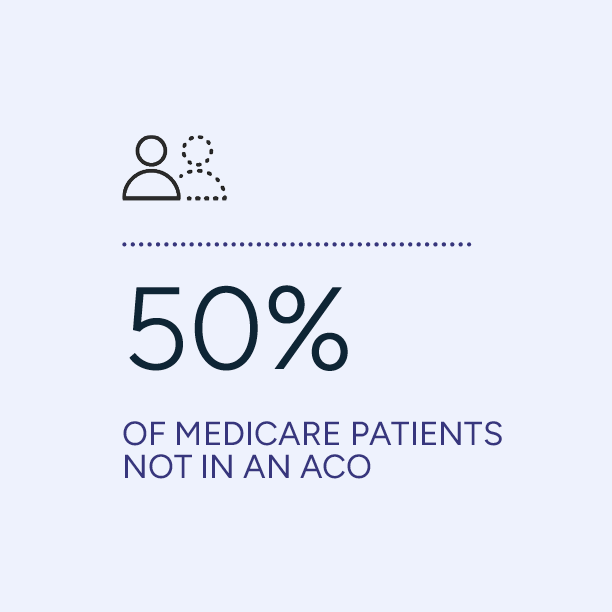
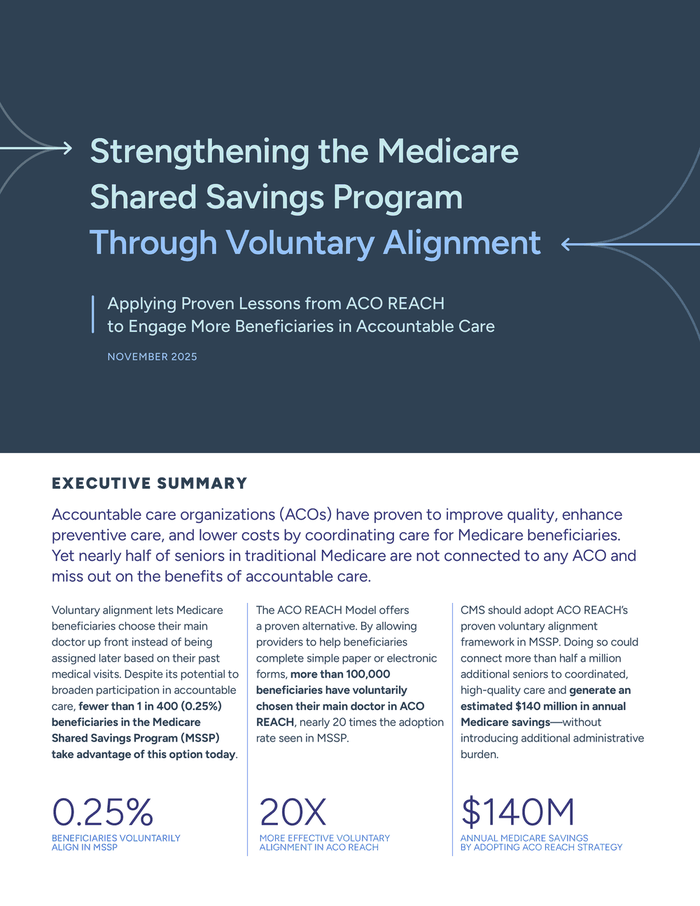
Voluntary alignment lets Medicare patients choose their main doctor, but fewer than 1 in 400 (0.25%) MSSP beneficiaries use this option today—leaving half of all FFS beneficiaries not connected to an ACO.

Voluntary alignment works. Now the benchmarks need to work too. 52 ACOs have asked CMS to fix how the LEAD Model benchmarks voluntarily aligned patients.
Our letter to the CMS Innovation Center: fair benchmarks for voluntarily aligned LEAD beneficiaries
Starting in PY 2027, LEAD sets a separate benchmark once an ACO has 500+ voluntarily aligned beneficiaries. That benchmark is built only from patients who were alive at the start of the year, so it leaves out end-of-life costs the ACO still has to cover. The result is a benchmark that understates expected spending and discourages ACOs from using voluntary alignment.
In October 2026, 52 ACOs asked CMS to set the voluntarily aligned benchmark no lower than the claims-based benchmark.
The Coalition for Accountable Care Access (CACA) brings together ACOs, provider organizations, and policy leaders to advocate for Signed Voluntary Alignment (SVA) and fair benchmarking for voluntarily aligned patients in the Medicare Shared Savings Program (MSSP), the LEAD Model, and future ACO models.
LEAD already includes voluntary alignment, a big step forward. But the way LEAD benchmarks those patients penalizes ACOs for using it. We’ve asked CMS to fix it starting in PY 2027. Get involved →
UPDATES:
In October 2026, 52 ACOs sent a letter to the CMS Innovation Center asking for fair LEAD benchmarks for voluntarily aligned beneficiaries.
In March 2026, the National Association of ACOs (NAACOS)—representing 120 ACO organizations—sent a letter to CMS requesting to adopt signed-voluntary alignment to expand beneficiary participation in ACO models.
In February 2026, nearly 30 accountable care organizations (ACOs) that care for millions of Medicare beneficiaries across the country sent a letter to CMS calling for reforms.
Millions of seniors still lack access to the coordinated, high-quality care that ACOs provide
IN MSSP
Voluntary alignment lets Medicare patients choose their main doctor, but fewer than 1 in 400 (0.25%) MSSP beneficiaries use this option today—leaving half of all FFS beneficiaries not connected to an ACO.
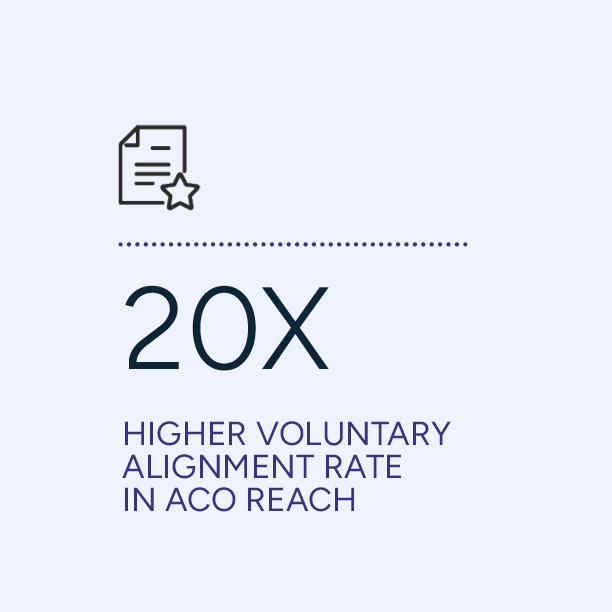
The ACO REACH Model offers a proven alternative—over 100,000 beneficiaries have chosen their doctor through simple paper or electronic forms, nearly 20× the MSSP rate.
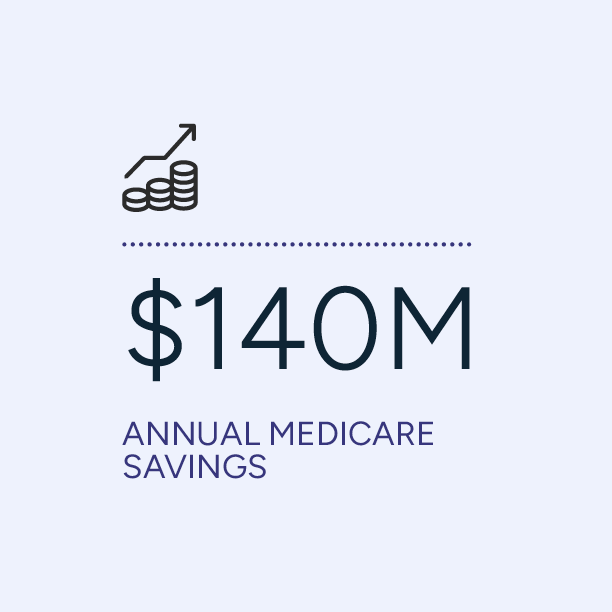
Adopting ACO REACH’s alignment process in MSSP could connect 560,000 more seniors to care and save Medicare $140 million annually.
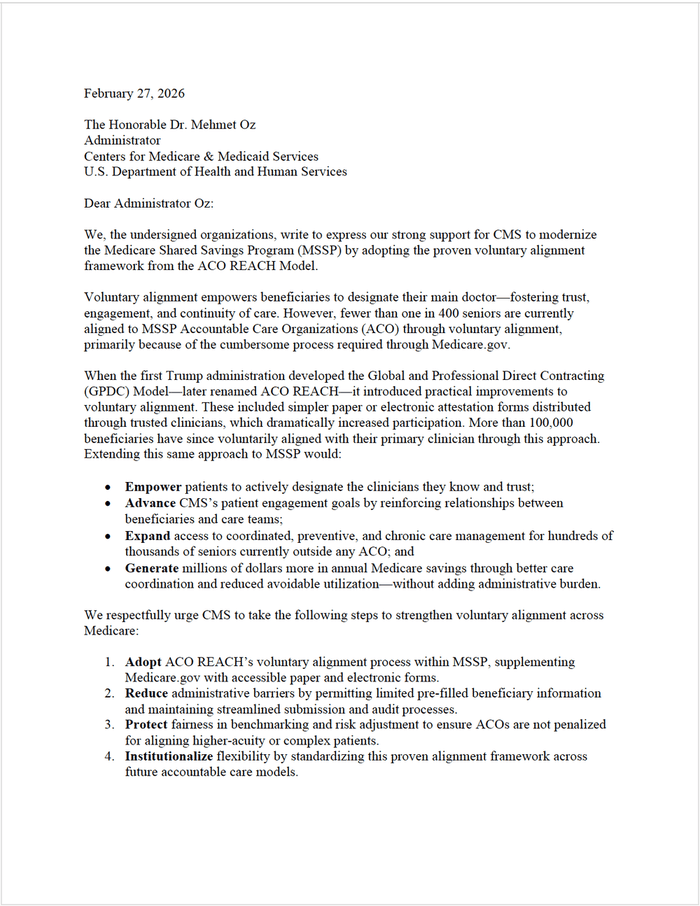
We’re calling on CMS to:
LEAD Model (letter sent October 2026)
MSSP & future models
Our October 2026 LEAD letter was signed by 52 ACOs, and our February 2026 MSSP letter by ~30 ACOs representing millions of Medicare beneficiaries nationwide
Final letter as sent to CMS
October 6, 2026
Abe Sutton, JD
Deputy Administrator and Director of the Center for Medicare and Medicaid Innovation
Centers for Medicare & Medicaid Services
U.S. Department of Health and Human Services
Dear Mr. Sutton:
We, the undersigned organizations, write to request a refinement, beginning with Performance Year (PY) 2027, to how the Long-term Enhanced ACO Design (LEAD) Model sets benchmarks for voluntarily aligned beneficiaries.
We strongly support LEAD’s expanded voluntary alignment pathway. The ACO REACH Model demonstrated that signed voluntary alignment (SVA) works: ACOs of many types and sizes used it to enroll patients in accountable care relationships of their own choosing. We appreciate CMS’s leadership in carrying that opportunity forward in LEAD, including allowing new beneficiaries to align each month.
Our concern is with how LEAD sets the benchmark for this population once an ACO’s SVA population reaches 500 beneficiaries. At that point, CMS applies a separate benchmark based on the historical spending of the beneficiaries who are voluntarily aligned in the performance year. Because every beneficiary in that cohort is alive at the start of the performance year, their historical spending excludes the end-of-life costs that a portion of the same population will incur during the performance year, costs for which the ACO remains fully accountable. This constant-cohort approach tends to understate expected costs.
Wakely Consulting Group and the Complex Care Alliance documented this effect and shared their analysis with CMS in June. For Aged and Disabled beneficiaries, prior-year spending fell 13.1 percent below performance-year spending under the constant-cohort approach, compared with 4.9 percent under standard attribution. The gap widened after risk adjustment. Those results predate the updated LEAD risk models and are being reassessed, but the underlying concern with the constant-cohort approach remains and isn’t expected to be fixed with the new risk adjustment models. We also note that the Innovation Center encountered a similar dynamic in the Pioneer ACO Model and ultimately adjusted its approach.
We appreciate the changes the Innovation Center made to the voluntarily aligned benchmark methodology for High Needs-eligible beneficiaries. While the changes meaningfully improve the methodology, they do not, however, fully resolve the concern for those beneficiaries, and the methodology for the Aged and Disabled category was unchanged. As a result, a number of ACOs, including some of the undersigned, are planning to voluntarily align significantly fewer beneficiaries than they otherwise would. We are concerned that use of the voluntary alignment pathway, and overall attribution to LEAD, may fall well short of what CMS intends.
RECOMMENDATION: When an ACO has more than 500 voluntarily aligned members, and the voluntarily aligned benchmark applies, CMS limits it to a range from 10 percent below to 10 percent above that claims-based aligned benchmark. We request that CMS raise the lower bound to 100 percent of the claims-based aligned benchmark. Whenever the voluntary-aligned benchmark falls below the claims-based aligned benchmark for the same category, the latter would apply. This would protect against an understated baseline while preserving a higher benchmark for voluntarily aligned populations whose historical spending supports one.
Alternatively, CMS could apply a benchmark adjustment at the eligibility-category level that accounts for the cost of mortality in the performance year that doesn’t exist in the base years. This could be applied consistent with how we understand CMS is applying the seasonality adjustment to beneficiaries added mid-year under the hybrid alignment methodology.
We appreciate that the Innovation Center has indicated that in future years they will use the experience with voluntarily aligned members in the early years to support a more accurate benchmark. We recommend CMS apply one of our suggested policies in PY 2027 and for every subsequent year the constant cohort benchmark methodology is used.
Thank you for your leadership and consideration of this request. We welcome the opportunity to discuss implementation. For questions or further discussion, please contact David Pittman at david@pittmanpolicy.com.
Sincerely,